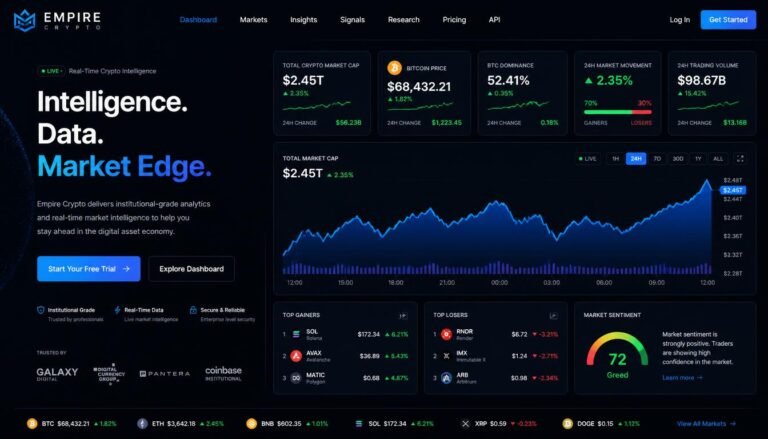
The digital economy is going through a massive shift. In traditional finance, transaction data is locked behind corporate firewalls and banking privacy laws. In the Web3 world, the paradigm is inverted: blockchains are entirely public, open-source databases. Every transaction, asset transfer, smart contract interaction, and wallet balance is broadcast to the world in real-time.
This means that the biggest barrier to success in the blockchain industry isn’t access to information—it is the ability to interpret it. The raw ledger is a firehose of hexadecimal strings and machine code. Mastering on-chain data analytics allows you to cut through market hype, audit Crypto Data Online applications, and build verifiable technical skills.
This comprehensive guide serves as a practical blueprint for digital learners aiming to turn public blockchain records into actionable insights for career or development success.
1. The Anatomy of Public Ledger Data
To query a database effectively, you have to understand how it organizes and stores information. A blockchain is a distributed ledger maintained by a global peer-to-peer network of independent computers, or nodes.
Instead of writing data line-by-line, the network packages data chronologically into structures called Blocks.
┌────────────────────────────────────────────────────────┐
│             CRYPTOGRAPHIC CHAIN LINK MECHANISMS        │
├────────────────────────────────────────────────────────┤
│ [ Block #100 ] -> Has unique Hash: 0x4a9b...           │
├────────────────────────────────────────────────────────┤
│ [ Block #101 ] -> Contains Parent Hash: 0x4a9b...      │
│                -> Has unique Hash: 0x7e2c...           │
├────────────────────────────────────────────────────────┤
│ [ Block #102 ] -> Contains Parent Hash: 0x7e2c...      │
└────────────────────────────────────────────────────────┘
Every block is cryptographically tethered to the one before it using a parent hash (a unique digital fingerprint of the previous block’s data). If anyone tries to retroactively alter an old entry, that block’s hash changes instantly, breaking the mathematical chain link. The network of nodes will immediately reject the change. This ensures the data remains entirely immutable (unchangeable).
2. Navigating Block Explorers Like a Data Analyst
The first milestone in smart blockchain learning is mastering Block Explorers. Think of these as public search engines for blockchain databases. Popular examples include Etherscan (for Ethereum), Solscan (for Solana), and Blockchain.com (for Bitcoin).
Instead of treating an explorer like a receipt checker, use it to track capital flows and audit network behaviors using this standard process:
1.Isolate the Transaction Hash:Copy the identifier.
Locate the 64-character alphanumeric string known as the Transaction Hash (TxHash) or grab the public wallet address you want to audit.
2.Query the live explorer:Search the engine.
Paste the alphanumeric string directly into the main search field of the respective network explorer (e.g., Etherscan.io).
3.Confirm finality status:Verify settlement state.
Check the Status row. Ensure it explicitly displays Success to verify the data transaction is permanently written to the ledger.
4.Trace the asset path:Audit data metrics.
Analyze the From and To fields to map exactly how funds moved between addresses. Check the Gas/Transaction Fee line to calculate the cost paid to network validators.
3. Demystifying Token Economics (Tokenomics)
A common mistake for beginners is evaluating a crypto asset based entirely on its individual unit price. An asset trading at $\$0.50$ per coin isn’t necessarily “cheaper” than an asset trading at $\$500$. To determine a project’s true size, you must calculate its Market Capitalization:
$$\text{Market Capitalization} = \text{Current Token Price} \times \text{Circulating Supply}$$
When parsing project pages on aggregators like CoinGecko or CoinMarketCap, look closely at the supply metrics to evaluate token health:
- Circulating Supply: The exact quantity of tokens unlocked and actively changing hands in public markets.
- Max Supply: The absolute mathematical limit of tokens that will ever be minted for that project.
- Fully Diluted Valuation (FDV): The theoretical market capitalization if the entire max supply were already circulating at the current token price.
The Inflation Risk Indicator: If a project has a low circulating supply but a massive max supply, its FDV will be significantly higher than its current market cap. This indicates a large volume of tokens is still locked up for developers, early backers, or future emissions. As those tokens unlock and enter the market, they introduce inflationary supply pressure that can drag down the token’s price unless demand scales at an equal pace.
4. Tracking Protocol Economics in DeFi
Beyond simple token transfers, smart learning involves tracking decentralized applications (dApps), such as automated lending protocols or decentralized exchanges (DEXs). The industry standard for evaluating these systems is DeFiLlama.
Look past volatile market prices and focus on core Crypto Data Online data:
Total Value Locked (TVL)
TVL represents the total dollar value of crypto assets deposited inside a protocol’s smart contracts. A rising TVL indicates growing user trust, protocol utility, and deeper liquidity, serving as a reliable sign of functional network adoption.
Protocol Revenue and Capital Efficiency
Top protocols generate clear revenue by charging small fees on user actions. By tracking a protocol’s daily volume relative to its TVL, you can determine its capital efficiency. A platform that processes significant volume with a lean asset pool demonstrates strong product-market fit.
5. Coding Custom On-Chain Queries with SQL
The highest level of digital literacy in blockchain analytics involves writing custom code to extract insights directly from raw blockchain databases. Dune Analytics is a free, web-based platform that organizes raw blockchain event streams into structured relational database tables that anyone can query using standard SQL (Structured Query Language).
The Dune Data Hierarchy
Dune handles the heavy lifting by processing raw node data into three readable table layers:
| Table Layer | System Focus | Analytical Use Case |
| Raw Tables | Base network logs (ethereum.transactions) | Monitoring low-level block activity or calculating network gas trends over time. |
| Decoded Tables | Specific smart contracts (uniswap_v3.Pair_evt_Swap) | Isolating and auditing the inner logic of specific decentralized applications. |
| Spells (Cleaned) | Core ecosystem abstractions (dex.trades) | Running aggregate metrics across multiple competing platforms simultaneously. |
Writing Your First Crypto Analytics Query
Inside the Dune query editor, you can pull clean data out of massive database tables by typing structured instructions. For example, if you want to pull the daily transaction volume of an entire decentralized network over the last 30 days, run this simple query:
SQL
SELECT
    DATE_TRUNC('day', block_time) AS trade_date,
    SUM(amount_usd) AS daily_volume_usd
FROM
    dex.trades
WHERE
    block_time >= NOW() - INTERVAL '30 days'
GROUP BY
    1
ORDER BY
    trade_date DESC;
This short script filters through millions of raw transaction lines, sums up the real-world USD values, groups them chronologically by date, and produces a clean data table that you can convert into an interactive line chart with a single click.
Your Action Plan for Blockchain Success
To turn these concepts into practical digital skills, focus on hands-on application:
- Verify Claims Independently: When a project highlights explosive adoption on social media, don’t just take their word for it. Look up the project’s contract address on a block explorer or a public Dune dashboard. Check the count of unique active user wallets to see if the claims match reality.
- Fork Existing Community Code: You do not have to build complex databases from scratch right away. Create a free account on Dune Analytics, explore trending community dashboards, and click “View Query” on charts that interest you. Modifying and playing with working code is one of the fastest ways to learn.
- Practice Safely on Testnets: Never test transaction logic or smart contract tools with real capital. Set your crypto wallet extension to a developer test network (such as Ethereum Sepolia or Solana Devnet). Acquire free playground tokens from public faucets to practice executing transactions and reading the resulting on-chain logs at zero financial risk.
By keeping your learning path grounded in verifiable public ledger data, you can cut through market noise and build valuable, technical analytics capabilities.