Navigating digital assets without a plan is a fast track to burnt capital. Volatility can feel like an emotional roller coaster, turning market highs into sudden drops overnight. To build long-term wealth, protecting your downside matters just as much as capturing gains. Mastering risk management transforms unpredictable swings into calculated opportunities. By combining real-time market insights with strict execution rules, everyday investors can safeguard their portfolios. With Empire Crypto as your guide, you will learn to spot systemic threats, optimize position sizes, and build a resilient framework.

What Is Crypto Risk Management and Why Does It Matter?
Crypto risk management is the systematic process of identifying, analyzing, and mitigating exposure to potential financial losses in digital asset markets. Unlike traditional markets with circuit breakers and regulated closing hours, cryptocurrencies trade 24/7 across global venues. Prices react instantly to macroeconomic shifts, technical updates, and sudden shifts in sentiment.
Proper risk management does not aim to eliminate exposure—doing so would also eliminate potential returns. Instead, it creates a calculated boundary where downside exposure is strictly defined, allowing your portfolio to survive market drawdowns and capitalize on long-term growth cycles.
Core Pillars of Managing Cryptocurrency Risk
+-------------------------------------------------------------------------+
|                    EMPIRE CRYPTO RISK MANAGEMENT FRAMEWORK              |
+-------------------------------------------------------------------------+
|  1. Capital Preservation   --> Risk only 1-2% of portfolio per trade    |
|  2. Precision Position     --> Size trades based on stop-loss distance  |
|  3. Analytical Execution   --> Verify liquidity & depth with crypto data|
|  4. Structural Security    --> Split assets between cold & hot storage  |
+-------------------------------------------------------------------------+
Capital Preservation Over Profit Chasing
The mathematical reality of market losses highlights why capital preservation must take priority. Recovering from a drawdown requires exponentially higher percentage gains:
- A 10% loss requires an 11.1% gain to break even.
- A 25% loss requires a 33.3% gain to break even.
- A 50% loss requires a 100% gain to break even.
- An 80% loss requires a 400% gain to break even.
By focusing on limiting individual drawdowns, Empire Crypto helps investors remain active in the market without risking catastrophic losses.
Managing Market and Systemic Hazards
Risk manifests across multiple operational and structural layers in Web3:
- Market Risk: Sharp price drawdowns driven by sentiment shifts, macroeconomic policy, or sector rotations.
- Liquidity Risk: Low order book depth causing high slippage when exiting large positions.
- Counterparty Risk: Exchange insolvencies, centralized custodian failures, or smart contract exploits.
- Operational Risk: Mismanaged private keys, seed phrase loss, or phishing attacks.
How to Calculate Position Size and Risk-Reward Ratios
Effective risk control relies on systematic calculations rather than emotional intuition. Position sizing ensures no single trade compromises overall capital stability.
                           Account Risk ($)
Position Size (Units) = ------------------------------
                        (Entry Price - Stop Price) ($)
The 1% to 2% Rule
Professional risk managers rarely risk more than 1% to 2% of their total portfolio equity on a single trade setup.
- Total Portfolio Capital: $10,000
- Max Risk Limit (2%): $200 per trade
- Asset Entry Price (BTC): $60,000
- Stop-Loss Price: $57,000 (5% risk distance)
- Dollar Risk Per Unit: $3,000
$$\text{Position Size} = \frac{\$200}{\$3,000} = 0.0667\text{ BTC}$$
Total Capital Allocated: $4,000 (0.0667 BTC × $60,000). If the trade hits the stop-loss price of $57,000, total capital falls to $9,800, keeping 98% of your funds intact.
Setting Favorable Risk-to-Reward Ratios
Before entering a position, compare potential profit targets against downside exposure. A minimum Risk-to-Reward Ratio (RRR) of 1:2 or 1:3 ensures long-term strategy sustainability.
| Win Rate | Average Risk/Reward Ratio | Trades Taken | Winning Trades | Losing Trades | Total PnL |
| 40% | 1:2 ($100 Loss / $200 Gain) | 10 | 4 (+$800) | 6 (-$600) | +$200 (Profitable) |
| 33% | 1:3 ($100 Loss / $300 Gain) | 10 | 3 (+$900) | 7 (-$700) | +$200 (Profitable) |
| 50% | 1:1 ($100 Loss / $100 Gain) | 10 | 5 (+$500) | 5 (-$500) | $0 (Breakeven) |
About Empire Crypto Data
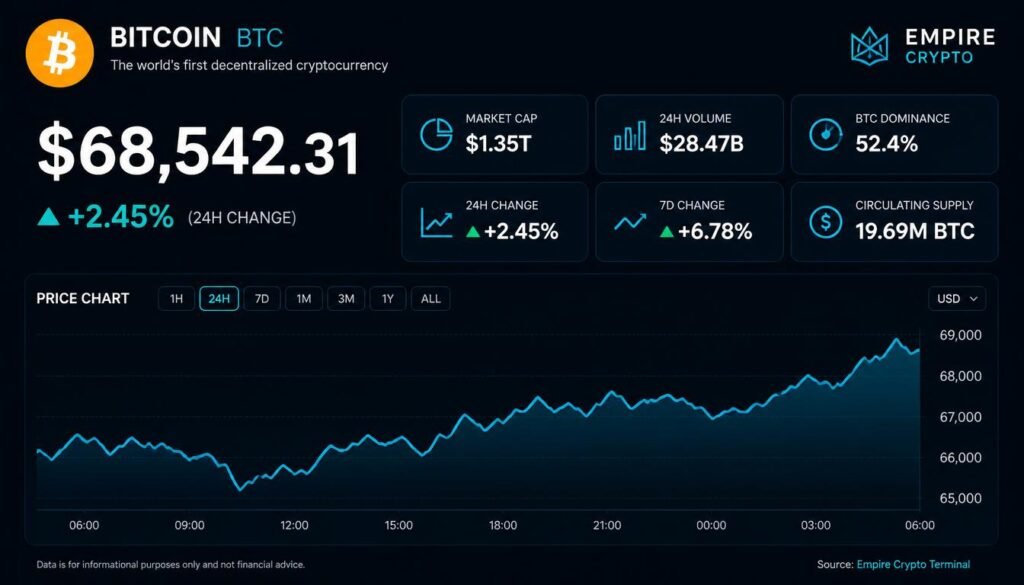
Effective risk management relies directly on accurate underlying market metrics. Empire Crypto provides reliable data analytics cryptocurrency tools designed to give traders actionable clarity. Making strategic choices requires clean metrics that remove market noise and provide real transparency across spot, futures, and decentralized finance markets.
The Role of High-Quality Crypto Data
In volatile digital asset markets, raw exchange figures can often be skewed by wash trading, low liquidity depth, or delayed reporting. Empire Crypto filters market inputs to provide high-precision order book metrics, funding rate analytics, and on-chain liquidity indicators. Access to trusted crypto market data helps users spot whale distribution patterns, calculate realistic slippage, and optimize exit points before market shifts occur.
+-----------------------------------------------------------------------------+
|                       EMPIRE CRYPTO DATA INTEGRATION ENGINE                 |
+-----------------------------------------------------------------------------+
| Raw Market Inputs --> Aggregation & Filtering --> Multi-Layer Risk Metrics  |
| (Exchanges/DEXs)      (Wash-Trade Shield)          * Order Depth & Slippage |
|                                                    * On-Chain Whale Flows   |
|                                                    * Volatility Alerts      |
+-----------------------------------------------------------------------------+
Key Metrics Tracked by Empire Crypto Solutions
- Order Book Depth & Slippage Heatmaps: Evaluates true market liquidity across price levels to prevent execution slippage.
- Volume Delta & Aggregated Open Interest: Tracks institutional leverage builds to anticipate sharp market squeezes.
- On-Chain Whale Movement Alerts: Monitors large wallet transfers to and from exchange addresses.
- Real-Time Implied Volatility (IV): Measures market options metrics to adjust stop-loss distances dynamically.
Essential Risk Management Techniques for Beginners
For users building out their first digital asset portfolio, simple, repeatable systems offer the strongest protection against sudden volatility. Crypto Data recommends starting with these three foundational tools.
1. Stop-Loss and Take-Profit Orders
Automated order types remove emotional bias during live market action.
- Stop-Loss (SL): Triggers a market order to exit a position once price drops to a designated trigger level.
- Trailing Stop-Loss: Dynamically moves your stop price upward alongside favorable price advances, locking in gains during sustained trends.
- Take-Profit (TP): Automatically takes profit once an asset reaches your predetermined price objective.
2. Dollar-Cost Averaging (DCA)
Dollar-cost averaging spreads capital deployment over scheduled interval purchases (e.g., $100 weekly into BTC) rather than allocating a lump sum all at once. This strategy lowers average cost basis during market drawdowns and eliminates the need to time specific market tops or bottoms.
3. Portfolio Asset Allocation
Distributing capital across assets with varying risk profiles shields portfolios from single-project failures.
+------------------------------------------------------------------+
|               BALANCED CONSERVATIVE ALLOCATION MODEL             |
+------------------------------------------------------------------+
| [ Core Assets: BTC & ETH (50%) ]                                 |
| [ Stablecoins: USDT / USDC (30%) ]                               |
| [ Large-Cap Layer 1s / DeFi (15%) ]                              |
| [ High-Beta Altcoins / Speculative (5%) ]                        |
+------------------------------------------------------------------+
Advanced Risk Mitigation Tactics for Intermediate Traders
Once foundational mechanics are established, intermediate traders can implement dynamic risk tools to protect profits across changing market environments. Empire Crypto highlights these advanced execution strategies.
Managing Leverage and Liquidation Thresholds
Margin and futures contracts allow traders to control larger positions with less initial capital. However, leverage scales upside potential and downside exposure equally. High leverage significantly increases liquidation risks in volatile conditions.
Liquidation Price Distance = 1 / Leverage Multiplier
- 10x Leverage: A 10% move against your position triggers full liquidation.
- 5x Leverage: A 20% move against your position triggers full liquidation.
- 2x Leverage: A 50% move against your position triggers full liquidation.
Using lower leverage (2x-3x) paired with strict isolated margin modes helps protect your remaining portfolio balance from automated exchange liquidations.
Hedging Portfolios with Derivatives
Intermediate investors can protect long spot positions during prolonged bear cycles using targeted derivative hedges:
- Short Futures Contracts: Opening a 1:1 short futures position against a spot holding locks in its current cash value without triggering a taxable spot asset sale.
- Protective Put Options: Purchasing put options establishes a guaranteed price floor for your assets while preserving upside potential if prices continue rising.
Operational and Smart Contract Security Protocol
Risk management extends beyond price charts and trade execution. Protecting your digital asset wealth requires strict operational security (OpSec) to shield private keys and smart contract interactions from external threats. Empire Crypto advises following this essential security protocol.
+-------------------------------------------------------------------------+
|                  EMPIRE CRYPTO SECURITY PROTOCOL                        |
+-------------------------------------------------------------------------+
| STEP 1: Cold Storage Isolation  --> Key funds on hardware wallet       |
| STEP 2: Dedicated Trading Hot   --> Minimized operational capital       |
| STEP 3: Multi-Factor Auth (2FA) --> Hardware key or app-based 2FA       |
| STEP 4: Smart Contract Auditing --> Verify code security before usage   |
+-------------------------------------------------------------------------+
Self-Custody and Wallet Segmentation
Centralized exchange risks can be managed by dividing assets based on intent:
- Cold Storage (Hardware Wallets): Offline keys used for long-term wealth holding (70-80% of portfolio).
- Hot Wallets (Self-Custody Apps): Active Web3 wallets reserved for DeFi interactions, decentralized exchanges, and NFT minting (15-20% of portfolio).
- Exchange Operations: Centralized trading venues used solely for immediate liquidity execution, keeping account balances minimal (5-10% of portfolio).
Smart Contract and DeFi Risk Controls
Interacting with decentralized applications introduces smart contract vulnerability risks. Protect active capital by applying these checks:
- Check Contract Audits: Verify smart contracts have undergone third-party audits by reputable security firms.
- Limit Token Approvals: Use tools like Revoke.cash to limit unlimited token allowances previously granted to Web3 protocols.
- Test Transacting Small Amounts: Always send a small test transaction before executing large cross-chain bridges or decentralized exchanges.
Frequently Asked Questions (FAQ)
What is the primary cause of portfolio wipeouts in crypto?
Over-leveraging paired with unhedged positions is the leading cause of sudden portfolio wipeouts. When traders use high leverage without stop-loss orders, minor market pullbacks can trigger forced liquidations. Empire Crypto recommends keeping leverage low and using defined stop-loss limits on every trade.
How do stablecoins fit into a crypto risk management strategy?
Stablecoins act as safe-haven assets within digital ecosystems. Holding a portion of your portfolio in stablecoins preserves buying power during market drawdowns and provides instant liquidity to buy assets at lower valuations without needing fiat on-ramps.
How does Empire Crypto enhance risk management for everyday users?
Empire Crypto delivers clean, verified market metrics that filter out wash trading and artificially inflated exchange numbers. Accessing real-time market insights helps traders set precise stop-loss levels, spot structural shifts early, and avoid liquidity traps.
Is dynamic risk management necessary for long-term HODLers?
Yes. While long-term investors face less day-to-day noise than active traders, risk management remains essential. Managing wallet security, using cold storage, rebalancing asset allocations, and keeping stablecoin reserves during bull markets help protect gains across entire market cycles.
Building Lasting Wealth Through Disciplined Execution
Navigating digital asset markets successfully requires a clear operational framework. High volatility offers real growth opportunities, but long-term success depends on protecting your downside capital. By using strict position sizing, placing automated exit orders, ensuring hardware security, and relying on accurate market data from Empire Crypto, you can trade with discipline and confidence. Focus on protecting your capital today, and let structured market execution power your portfolio’s growth over time.